|
| Elena, sciencing |
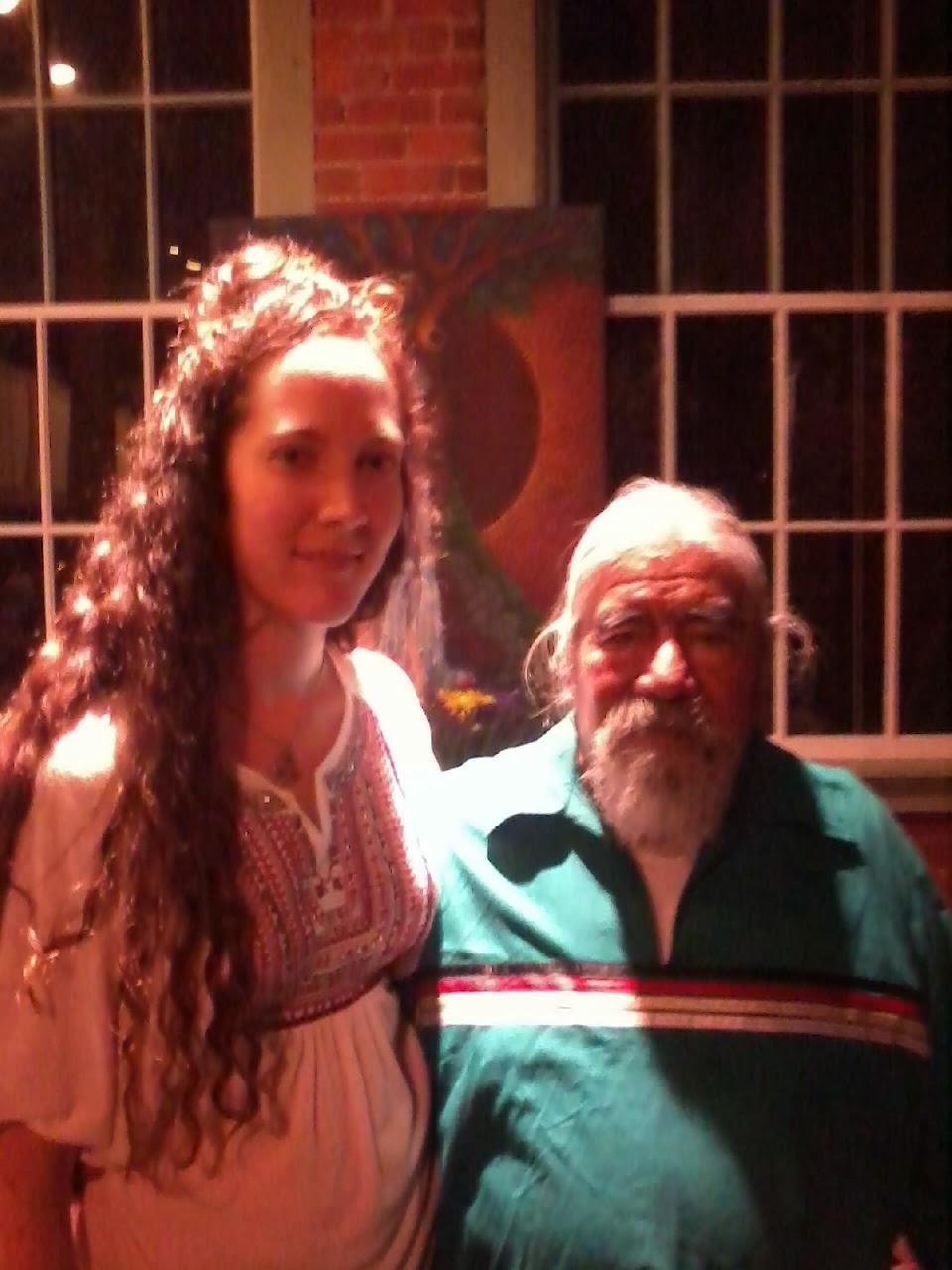
I have this friend, Elena. She's a scientist, which you can see here from this photo, which she has captioned, "This is how we science." Elena is a brilliant woman who does many things well with seeming ease. When I met her nearly years ago, we bonded over the Irish polka and penny whistle. I marveled at her drawings, etc.
Then she started to dream. Vivid dreams, lucid dreams, psi-dreams. She began asking questions of the dream, performing experiments, interacting with four-dimensional geometries, shape-shifting into dolphins. Her love of dance had found traction in the hall of night choreography, where possibilities are endless.
 |
| Here is me, like, totally dreaming, but my heart's not in it |
Meanwhile, I’d been rotely applying the science of dreaming — having dreams, writing them down, sharing them with my daughter, noting portent, responding appropriately in the waking world. Oneiromancy had become like brushing my teeth. In some ways, this is great. I’d established basic hygiene. But now I was behind the plate glass, lacking the curiosity that wells up in wonder.
My sizable well had been tapped by motherhood, work, and Twitter. My religious devotion to one-liners sipped at my spring constantly, leaving just enough seep to enliven some dreams, but not enough for a wave that rears up to look at itself before breaking. I was cool to just let the Moon do its thing, and roll with the tides. Unconsciousness is underrated. (Why do we fear death so much if we love sleep?)
My sizable well had been tapped by motherhood, work, and Twitter. My religious devotion to one-liners sipped at my spring constantly, leaving just enough seep to enliven some dreams, but not enough for a wave that rears up to look at itself before breaking. I was cool to just let the Moon do its thing, and roll with the tides. Unconsciousness is underrated. (Why do we fear death so much if we love sleep?)
Elena kept pestering me with her lucid dreams. “How do you do this?”, “What do I do next?”, “Give me a task!” , “Let’s meet up in a dream!” Her excitement became a little like a virus. Though exhaustion is the perfect antidote for adventure, I nevertheless found myself saying, “What the hell. Let’s do it.”
 |
| unattributed image depicting Australian Aboriginal Dreamtime |
So, what is a mutual dream? It’s where two or more people agree to meet up in a lucid dream. And what’s a lucid dream? It’s when you’re awake while you’re dreaming. Having a specific plan can focus mutual dreaming efforts. In our case, we decided to dream-meet at Tuk Tuk Thai. We planned what we would order, and agreed to exchange code words, which we would report back to each other upon waking. This is a good way to verify the experiment.
We agreed that we would not share our dream data until each of us had successfully become lucid, even if this occurred on different nights. A mutual dream can occur at the same time, even if the two parties dream it on two different nights. Dreamtime is a locus, like a sun, with rays emanating in lots of directions throughout space and time. People from the past, or people from parallel "nows" (including our many selves) can access the same fluid nexus. This is also why we can affect all times from the dreamworld, including the past.
Sharing our attempts is good because that's what most of coordinated dream tasks amount to. And it's fun. Right now, the strongest societal framework for dreamwork is modern psychology. Most of us stuff dreams into a psychology-shaped backpack, so when we unpack the dreams, it doesn't occur to us that they are anything other than psychology. (I like psychology as a friend, but I would not make out with psychology.) For some of us, dreaming is different, but our assumptions do not have as much gravity as the assumptions of 7 million other people; thus, we are pulled into pop culture's janky orbit.
 |
| still from Werner Herzog's Cave of Forgotten Dreams |
We're not going to "maximize" the dreamways using modern psychology. That's like saying we'll grok the universe through a pinhole viewer. Nevermind that the eye itself is a pinhole viewer. Dreaming today has a confused and spread-out framework, like a trip to IKEA. Many things can happen in IKEA, such as getting lost, but certain things are less likely to happen. We are less likely to receive a shamanic transmission from our ancestral lineage, the exchange of which can transpire only in a hidden dream locale that a prior initiate knows how to access on a certain night once a year, while our genealogical tribe, who shares a deep, mutual reality, holds ritual space.
So.
The short version of this story is that we accomplished some things, but not everything. The rest of this post will be for people who give a shit about other people's dreams. Also continue reading if you would like to see a horse rotate through four-dimensional space. Here I'm including my dreams on the nights that Elena became lucid, though as I mentioned, this data isn't necessarily relevant.
Attempt Number One (8/25/2015):
Elena: I see Erin nearby, also attending the festival. I have a recollection that I am supposed to meet with her, but at a later time and in a different place. Nevertheless, I call out to her and ask if she has time to talk for a bit. We take our food plates and pennywhistles and move away from the crowd at the tables. I want to go sit on the edge of the grassy green cliff overlooking the sea, and am disappointed when Erin leads the way to a spot where some bushes block the view. I resign myself, thinking that she must want to sit somewhere that is sheltered from the wind. As we sit down to eat and play whistles, I become captivated and distracted by the giant spinning pinwheels. When I comment to my companion how interesting it is that they become transient from spinning so fast in the wind, she is no longer Erin but my mother, and the place we are sitting is the grassy top step of some sandstone stairs that lead down towards the water, the view of which is no longer blocked by bushes[...]
Erin: something something Neil Gaiman
Synposis:
 |
| More of an epic fail on my part. Also, just kidding. You can't fail at dreams, kids. Follow them. Just kidding, don't. Go into tech. Trust me. Being a dreamer is hard. |
Attempt Number Two (9/1/2015):
Elena: I joyfully realize that I am now lucid dreaming. Quickly I try to think of what to do. I want to go explore my subconscious, but I remember that I have a plan to dream-meet Erin at Tuk Tuk Thai, which must take precedence. So I quickly tell the dream, "Dream, take me to Erin." Instantly I find myself in a dark room that has the air of an empty theater, library, or museum - the floors are dark mahogany and there are dark red velvet hangings around. It feels old and slightly dusty, disused - a faded grandeur. Lined up on the floor along one wall is a series of leatherbound books and old wooden picture frames.
There is a place near the middle of the row where a book and a picture frame are leaning in opposite directions, and I can see the picture within the frame: it is Erin's portrait looking up at me. I come up and try to engage her in conversation, but she only looks at me with a vague smile. I realize this probably means she is not lucid, but decide to quickly tell her my code word, "dodecahedron". Then I hesitate and think, maybe I should use "bivariate contour ellipse area" instead, since "dodecahedron" is too similar to "amplituhedron", and we had been talking about those in the waking world recently.
I thumb through the books to see if I can find another picture of her in which she might be lucid, but I'm unsuccessful. I ask the dream to take me to the real Erin, but feel a general feeling of hostility and annoyance build up until suddenly the book line explodes and books go flying in all directions. To me, this feels like an indication that I'm wasting my time, and should go take advantage of the dream, while I'm still in it, to try some other things. (I subsequently go flying through space and learn a lesson on spatial nonlocality and the arbitrary nature of "up" and "down" in a place where gravity is insignificant, after which I find out what it is like to be a dolphin.)
Erin: Lucid. I wake up in a dream and remember we are supposed to have a mutual dream. I basically wipe the scene clean in an act of will. I recreate/create TukTuk, our agreed meeting place, and conjure Elena. She is here. I try to remember what we agreed she would order, but I can only remember something with pumpkin curry. [When I wake up, I asked her and she reminded me it was octopus pumpkin curry.] I forgot that we were going to exchange code words. The code word I am going to give her is Zebra.
Synopsis:
 |
| Partial success, meta-evidenced by this unpaid-for stock photo that is relevant, but not quite successful. |
Attempt Number Three (9/21/2015):
Elena: The floor is covered in ugly brown tile and some toilets are outside their stalls, as well as really disgusting, and mismatched -- all different shapes and sizes. I realize my dream toilets are often like this, which prompts me that this is a dream. I [...] feel elated as I walk down the hallway away from the bathroom, reminding myself to stay calm and focus on my dream tasks. I come to a door and realize I can just walk through it so I do. I find myself in a dark room with dark wood floors. It feels like an old museum or theater. I remember that I wanted to experience the Aurora Borealis, so I ask to see the northern lights and "let go", letting the dream current take me. I can feel myself spinning and floating in an invisible vortex, but all I can see is darkness. I ask again but the image doesn't change.
I clarify with "Aurora Borealis," but still see mostly darkness with an emerging pattern of swirling, slightly lighter colors, but nothing intense... I give up for now and request to see an amplituhedron. [An amplituhedron is a fluid geometry that underpins phenomena.] I spin into a place of white light and vastness, which feels a bit like being above the clouds. At first I see a faint structure, transparent and crystalline with many facets, some of which have rounded edges, some of which have straight edges. As I think, "Ooh, it worked!" the image gets more intense. It is growing and morphing as more crystals constantly come into being and disappear, accompanied by crackling and electric flashes of bluish light. It's like a giant ever-changing multidimensional snowflake combined with metallic electricity[...]
The amplituhedron reminds me that I need to find Erin, so I tell the dream I want to see her, but she doesn't appear. Then I realize I've been saying the requests discreetly in my head, and maybe that's why the answers are appearing discreetly in my head, too. I'm in a dream and I can shout if I want to, no need to be shy, so I do. There is a dream character nearby in front of a door, dancing or making out with some sort of doll or mannequin. They ignore me so I continue talking loudly. I say, "I want to see Erin Langley!"
I keep repeating it but the dream is becoming unstable. I can feel myself waking up. I know that I am waking into another dream, a false awakening, as the scene in the room into which I awaken is dark with burgundy velvet curtains and someone is nearby, both of which I know aren't true of my waking world sleeping situation. I tell myself to go back to sleep, and emerge into another dream in which I'm still vaguely aware that I was recently lucid, but am not lucid any longer. Finally I wake myself up because I don't want to forget the dream.
Erin: Tending a giant palomino. Reminiscing about barrel racing. [I was up most of the night with my sick daughter.]
Synopsis:
Let us not focus on failure, but instead upon this video which shows us a horse rotating through four dimensions.
Elena's dreams clearly show that I have become a dream curmudgeon. Yet, I am delighted to have read today that she chose "dodecahedron" as the code word. It's my favorite solid. "Bivariate contour ellipse area" is a fantastic auxiliary. I went with something striking and easy--something short, with a 'z'. Still I forgot.
The "successful" mutual dreams I've experienced have been unplanned and non-lucid. One visceral night in 2006, my skeptical ex-husband and I had the same bizarre, highly-detailed dream, non-sequitur to our waking conditions. Not even he could dismiss that. And interestingly, on the night of 9/20/2015, four people shared with me that they dreamed of mice and rats. In fact, Elena and I were both in a rodent sanctuary:
Elena: I rescued a bookshelf full of mice and was contemplating what to do with them. I adopted them from a mouse sanctuary. They were different colors, and a bunch of drowned pinkies. I worried about how they drowned.
Erin: An old babushka woman is after me. I escape to the place next door. I have a brown rat in my pocket. There are nets and nets of white rats in this building. It's like a white rat sanctuary. I put the brown rat there. I am safe here. The rat is safe.
 |
| despite all of this |
The parallels between Elena's lab work with mice, and our dream laboratory strike me now. In dreams, we are the mice, the researcher, the experiment, and the lab.
Maybe this is the closest we came to a mutual dream, and maybe it's the closest we will ever come. Elena and I love our laboratories so much that I'm sure the experiments will continue. I am thankful to her for making dreaming new again, or at least refreshing the work conditions. I'm looking forward to our date at Tuk Tuk, regardless. Perhaps after we order, we can figure out if we're dreaming.